
E-commerce Trends 2025 : 4 Key Strategies to Drive Sales
By: Digitize Info System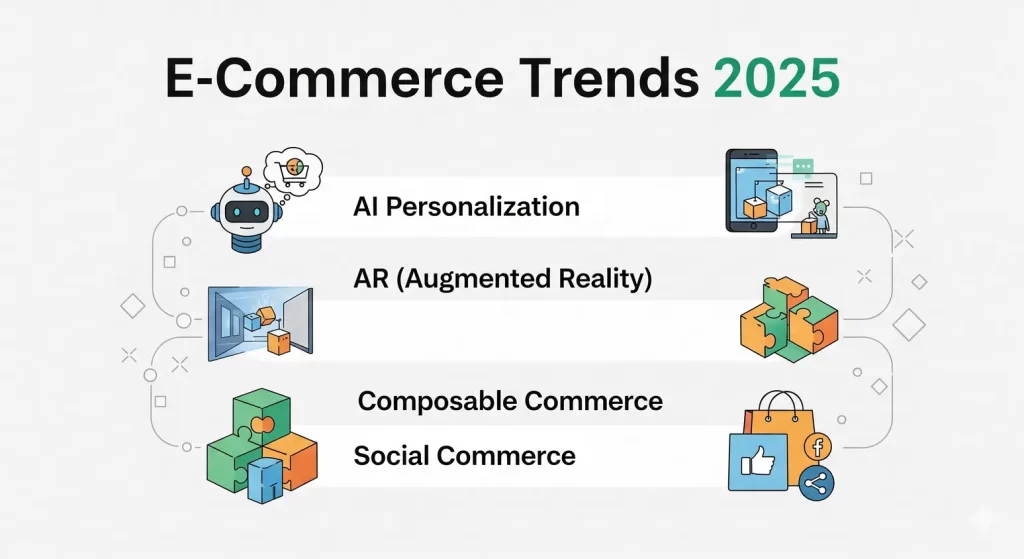
E-commerce Trends That Will Drive Sales in 2025
The global e-commerce market is projected to exceed $8.1 trillion by 2026, but with this explosive growth comes fierce competition. Simply having an online store is no longer enough. To capture market share and drive sales, businesses must deliver sophisticated, engaging, and highly personalized customer experiences. Staying ahead of the curve isn’t just an advantage; it’s a necessity.
This guide cuts through the noise to reveal the top e-commerce trends 2025 will be defined by. We’ll explore the technologies you need to adopt now to not only meet but exceed customer expectations and unlock significant revenue growth.
Why Yesterday’s E-commerce Strategy Won’t Work Tomorrow
The modern consumer is more demanding than ever. They expect seamless, intuitive, and personalized interactions across all touchpoints. A failure to innovate leads directly to cart abandonment and lost customer loyalty. The core challenge for businesses is moving from a transactional model to an experiential one. This is where leveraging the right technology becomes a critical business decision, directly impacting your bottom line and long-term viability.
Top E-commerce Trends to Implement for 2025
Here are the key trends backed by data that are reshaping the digital marketplace. Implementing these will be crucial for any business looking to thrive.
1. Hyper-Personalization Powered by AI
Generic marketing is dead. The future is about one-to-one personalization at scale. Artificial Intelligence (AI) is the engine behind this trend, analyzing customer data in real-time to deliver unique experiences.
- What it is: Using AI algorithms to provide dynamic product recommendations, personalized email campaigns, and customized website content for every user.
- Why it matters: According to a McKinsey report, companies that excel at personalization generate 40% more revenue from those activities than average players.
- Business Impact: Increased conversion rates, higher average order value (AOV), and enhanced customer loyalty. Integrating AI into a custom e-commerce platform is no longer a luxury; it’s a core driver of ROI.
2. Augmented Reality (AR) for Immersive Shopping
One of the biggest hurdles for online shopping is the inability to physically interact with a product. Augmented Reality (AR) effectively solves this problem, bridging the gap between digital and physical retail.
- What it is: “Virtual try-on” features for apparel and cosmetics, or AR viewers that let customers place a 3D model of furniture in their own room.
- Why it matters: Shopify data reveals that interactions with products having 3D/AR content showed a 94% higher conversion rate than for products without.
- Business Impact: Drastically reduced return rates, higher customer confidence, and a powerful marketing differentiator. This is especially transformative for industries like fashion, home goods, and beauty.
3. The Rise of Composable Commerce
Monolithic, all-in-one e-commerce platforms are becoming too rigid for the dynamic needs of modern business. Composable commerce is an approach that builds a flexible, best-of-breed technology stack by combining different microservices.
- What it is: Instead of one platform, you select individual components (e.g., a separate CMS, search function, and payment gateway) and connect them via APIs.
- Why it matters: A Gartner report predicts that by 2024, organizations that have adopted a composable approach will outpace the competition by 80% in the speed of new feature implementation.
- Business Impact: Unmatched agility to adopt new technologies, superior scalability, and the ability to create truly unique customer experiences without being limited by a single vendor. This is a key strategy for future-proofing your custom software development investments.
4. Social Commerce and Live Shopping
The customer journey no longer starts on your website. It starts on social media. Social commerce integrates the entire shopping experience—from discovery to checkout—directly within social platforms like Instagram, TikTok, and Facebook.
- What it is: Shoppable posts, in-app checkout, and live-streamed shopping events hosted by influencers or brand representatives.
- Why it matters: The global social commerce market is expected to grow three times as fast as traditional e-commerce, reaching $2.9 trillion by 2026.
- Business Impact: Access to a massive, engaged audience, shortened sales funnels, and increased impulse purchases.
Your Actionable Roadmap for 2025
Staying competitive requires a proactive strategy. Here are your next steps:
- Audit Your Current Tech Stack: Identify bottlenecks and areas where your current platform is limiting your ability to implement these trends.
- Prioritize Based on ROI: Start with the trend that offers the biggest impact for your specific industry. For most, AI-powered personalization is the logical first step.
- Partner for Expertise: Implementing these advanced technologies requires specialized skills. Working with an experienced offshore development partner provides access to top talent at a cost-effective rate.
The e-commerce trends 2025 will reward businesses that prioritize customer experience above all else. By investing in AI, AR, and a flexible commerce architecture, you can build a resilient and highly profitable online business for years to come.
Ready to Transform Your E-commerce Business?
Don’t let outdated technology hold you back. At Digitize Info System, we have over 8 years of experience building high-performance, scalable, and future-proof e-commerce solutions for global businesses. Our expert teams specialize in implementing the very trends that will define 2025 and beyond.
Let us help you build a custom e-commerce platform that drives sales, delights customers, and delivers a powerful return on investment.
Schedule Your Free E-commerce Strategy Session Today!